

Intense South Texas solar radiation degrades exposed exterior plumbing supply lines during peak summer months. June sun index spikes accelerate polymer decay, leaving braided hoses brittle and prone to sudden ruptures. Professional inspections and latex coatings prevent water waste and protect properties against catastrophic outdoor flooding in Castroville home yards.
The Solstice Threat vs Exterior Line Volatility
When the heavy rains of May give way to the relentless South Texas heat of June, homeowners in Medina County face a silent structural threat. Along the Medina River and throughout the subdivisions lining FM471, outdoor fixtures are subjected to some of the most intense solar exposure in the nation. During these summer afternoons, the UV index in San Antonio and Castroville routinely hits extreme levels of 13, delivering punishing ultraviolet radiation directly to exposed building surfaces.
While most residents understand the importance of shading their homes and protecting their skin, many ignore the physical impact this extreme solar radiation has on their outdoor plumbing. Exposed water supply lines in garages, outdoor kitchens, and backyard irrigation manifolds are under constant environmental stress. When high municipal water pressure—which frequently spikes up to 175 psi near regional pumping stations—combines with the weakening effect of UV rays, these exposed lines are primed for sudden and catastrophic failure.
The Science of Solar Polymer Chain Scission
To understand why your exterior hoses and plastic connectors fail so rapidly, we have to look at the process of photo-oxidation. Most modern flexible supply lines and outdoor pipes are constructed from polymers such as PVC, CPVC, and synthetic rubber. Under normal indoor conditions, these materials can easily last for decades.
However, when these materials are exposed to direct sunlight, they absorb high-energy UV-B radiation. This radiant energy physically attacks the molecular structure of the plastic, breaking the carbon-chlorine and carbon-carbon chemical bonds that hold the polymer chains together. This chemical change, known as chain scission, splits the long, flexible polymer chains into short, brittle segments.
When you run your fingers along an old, exposed PVC line or an unprotected outdoor hose, you will feel a distinct rough texture and notice a fine, chalky, powdery white residue rubbing off on your skin. This is the physical evidence of surface oxidation and pigment breakdown.
As the photo-oxidation process continues unchecked:
- Surface Chalking: The outer layer of the polymer loses its color, turning yellow or brown, and begins to peel.
- Micro-Cracking: Fine, hairline stress fractures develop across the surface of the pipe or connector.
- Embrittlement: The material loses its impact strength and elasticity, making it highly susceptible to cracking under slight physical contact or thermal movement.
- The Burst: The brittle inner elastomer core of your braided hose splits under normal household pressure, unravelling the weakened stainless steel outer sleeve and unleashing an unhindered flood.
Diagnostic Precision and Pressure Safety Audits
Many generic plumbing services will simply replace a burst hose and ignore the broader system failures that caused it. At Five Star Plumbing, we treat your outdoor system as a critical first line of defense. We utilize advanced, non-invasive diagnostic tools to verify the health of your entire system.
First, we connect a digital manometer to your outdoor spigot to run a dynamic pressure test. If your home’s main Pressure Reducing Valve (PRV) has failed—a highly common issue in master-planned developments—your water lines are being subjected to excessive pressure that stresses aging, sun-baked connectors.
Second, we utilize the LeakTronics Pro Complete Kit to run precise acoustic diagnostics. Our high-sensitivity transducers can “listen” through the rocky soil of Medina County, detecting the exact frequency of water escaping from sun-weakened underground irrigation joints before the leak can undermine your concrete slab or wash away your landscape.
Our Moment of Clarity occurs when the digital manometer registers a sudden, erratic drop in pressure under flow, while our acoustic probe isolates the exact coordinates of a sub-surface pipe shear, allowing us to execute a clean, minimally invasive repair.
Upgrading Exposed Lines the Right Way vs the Cheap Patch
When repairing sun-damaged outdoor lines, San Antonio homeowners must choose materials that can withstand both aggressive water chemistry and intense UV exposure.
- The Cheap Way: Replacing a sun-baked hose with a cheap, unshielded vinyl line or a basic PVC adapter from a big-box store. Standard transparent or light-colored PVC has very low UV resistance and will degrade within one to two years of direct sun exposure. Cheap braided stainless steel lines rely on thin EPDM rubber inner cores that degrade rapidly when exposed to heat and chlorinated municipal water, leading to early failure.
- The Five Star Way: We replace vulnerable lines with professional-grade, UV-stabilized materials. We specify PEX-a piping or heavy-duty CPVC formulations that contain integrated UV blockers like carbon black and titanium dioxide. Carbon black particles act as highly efficient UV absorbers, shielding the polymer backbone from direct solar radiation and extending the outdoor lifespan of the line significantly. Additionally, we utilize solid brass compression fittings that resist the dezincification and pitting caused by local hard water.
| Piping Material | UV Resistance | Heat Build-Up Risk | Typical Lifespan Outdoors |
| Unshielded PVC | Low | High (Prone to cracking) | 1 to 2 Years |
| Black Polyethylene | High | Moderate (Absorbs heat) | 4 to 6 Years |
| UV-Stabilized CPVC | Exceptional | Low (Treated with blockers) | 10+ Years |
| Brass-Shielded PEX-a | Exceptional | Low (Flexible and robust) | 15+ Years |
Early Summer Maintenance Checklist for South Texas Yards
To protect your exterior fixtures and maximize the life of your outdoor connections before the peak summer heat wave arrives:
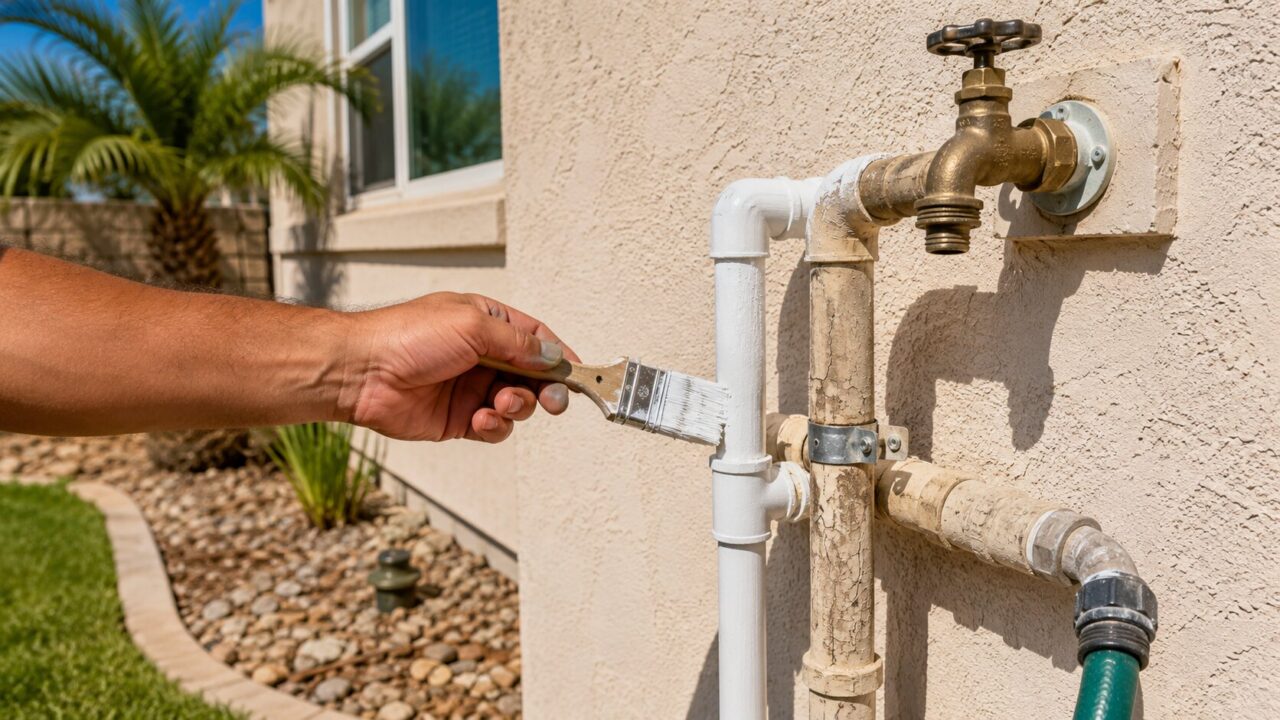
- Apply Latex Paint: Paint exposed PVC or CPVC water lines with a high-quality, water-based latex paint. The paint creates an opaque barrier that blocks UV rays and slows down photo-oxidation. Avoid oil-based or petroleum-based paints, as they are chemically incompatible and will damage the plastic.
- Disconnect Your Hoses: Never leave garden hoses connected and pressurized under the hot summer sun. The intense heat expands the water inside the hose, creating extreme static back-pressure that can rupture your spigot’s internal gaskets and cause leaks inside your walls.
- Install Faucet Covers: Utilize insulated outdoor faucet covers even in the summer. While designed for winter freezes, they are highly effective at shielding your brass spigots and delicate plastic timers from direct solar radiation.
- Group Lines in Shaded Corridors: When routing new outdoor lines, place them under roof overhangs or behind structures to minimize direct sky exposure.
Stop Sun Damage and Protect Your Faucets Today
Are your outdoor spigots showing signs of white chalking, rust, or weak spray? Do not wait for an exposed line to burst and flood your yard or garage. At Five Star Plumbing, we provide the diagnostic precision and rugged, UV-stabilized materials needed to handle South Texas’s brutal climate. Julian Campos and our certified team specialize in outdoor fixture inspections, water pressure calibration, and weather-ready upgrades. Reach out to Five Star Plumbing at (210) 673-0797 and at 2780 FM471, Castroville, TX 78009 today to schedule your early summer outdoor plumbing inspection and secure your property before the summer heat wave peaks!
Frequently Asked Questions
Does the sun actually weaken my outdoor plumbing hoses?
Yes, intense solar ultraviolet (UV) radiation breaks the chemical bonds in exposed polymer lines through photo-oxidation, leading to surface cracking, browning, and severe embrittlement.
Can I paint my exposed PVC pipes to protect them from the sun?
Yes, applying light-colored, water-based latex paint creates an opaque barrier that blocks UV rays, slows down surface oxidation, and keeps surface temperatures cooler to prevent cracking.
Are braided stainless steel hoses safe to use outdoors?
No, standard braided hoses have a thin internal EPDM rubber core that degrades rapidly when exposed to heat, chlorine, and indirect UV light, causing the inner hose to swell and burst through the steel.
Should I disconnect my garden hose during the summer?
Yes, leaving a hose connected under constant pressure during hot June afternoons traps heat and generates static back-pressure, accelerating the wear on your faucet’s internal gaskets and connectors.
