

Legacy plumbing in Castroville experiences localized failure during May due to expansive clay soil movement and high humidity. These environmental factors accelerate galvanic corrosion at iron-to-copper junctions and stress brittle galvanized threads. Internal pipe scaling further restricts flow velocity, causing hydrostatic pressure spikes that compromise aged supply-line integrity.
Why did your faucet lose pressure near Main Street?
I am currently staring down the bore of a galvanized supply riser pulled from a home near the Alsatian Landmark. To the homeowner, it looked like a simple case of low city pressure. Internal tuberculation has produced a jagged iron oxide layer, reducing the functional interior diameter by 60%. As I run a bore brush through it, the resistance is immense. This isn’t just a clog. It is a fundamental failure of the material.
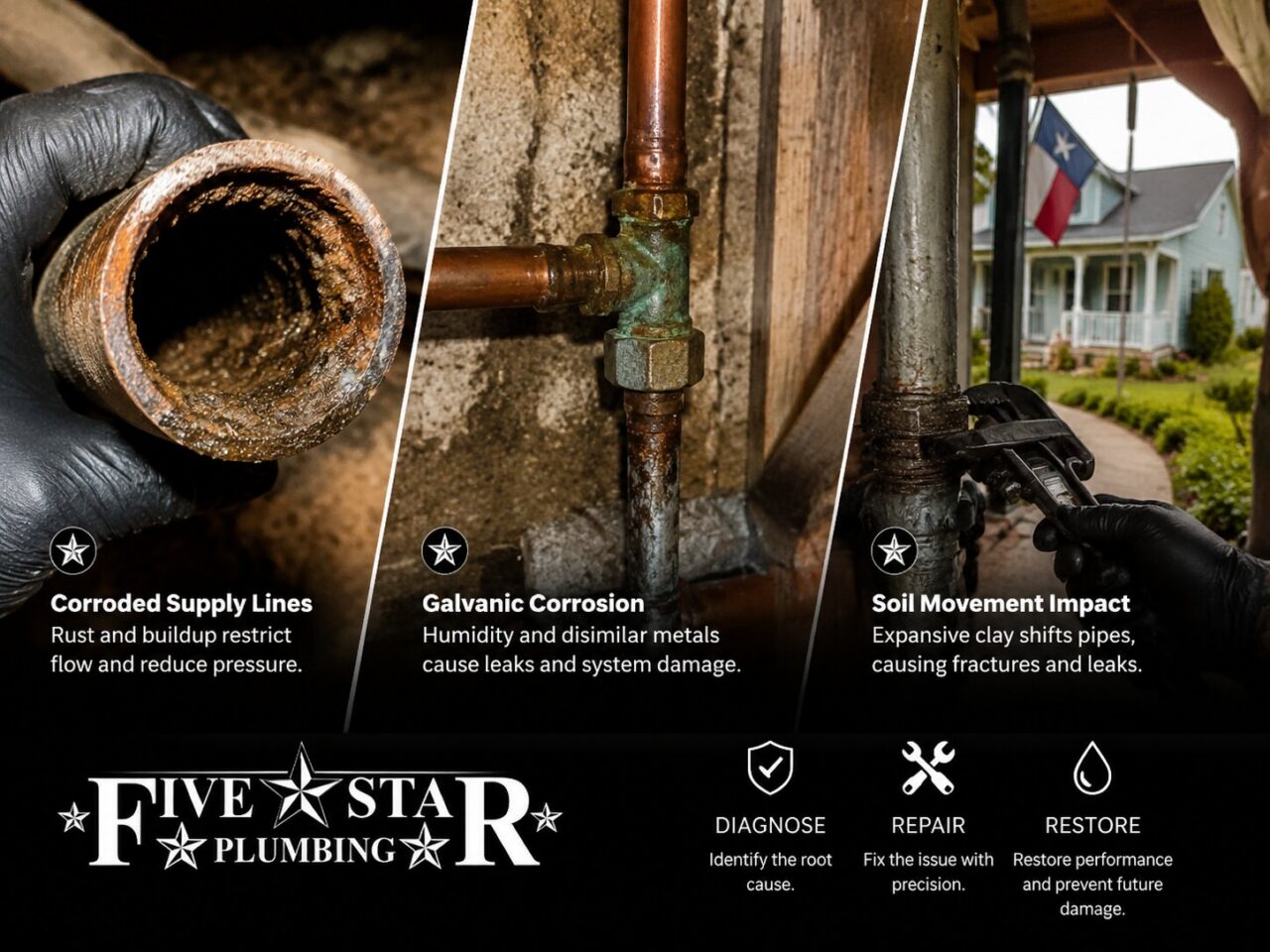
The Tuberculation Factor
When water flows through these narrowed passages, the velocity exceeds the recommended 5 feet per second. In this specific historic-district residence, the transition to a modern flex line has created a venturi effect. I hooked up my digital manometer and recorded a 15 PSI pressure differential across the fitting. This imbalance triggers a rhythmic water hammer every time the faucet shuts off, eventually vibrating the 1940s lead-solder joints until they weep.
Analyzing the Dielectric Failure in Alsatian Architecture
The humidity in Medina County is currently hovering at 82%, and you can feel it in the crawlspace. I am inspecting the supply lines behind a vintage pedestal sink. There is a heavy coating of green bloom—copper carbonate—crusting over the junction where the copper line meets the iron pipe. This is a textbook dielectric failure. While the standard plumbing code suggests a basic union is enough, the damp Castroville spring air acts as a constant electrolyte.
Identifying the green bloom of galvanic corrosion
I find that these factory unions fail in our local climate unless I manually back-fill the interface with silicone grease. Without that barrier, the galvanic current is unrestricted. I use a wire brush to clear the crust, revealing a pinhole leak that has been feeding on the pipe wall for months. The air in the bathroom carries that sharp, sour, metallic scent of oxidized iron water, a sensory red flag for any technician working these historic blocks.
How soil expansion shears rigid risers during May rains
The ground near the Medina River is currently saturated, and the high-plasticity clay is doing exactly what it was designed to do: expand. As the soil lifts the pier-and-beam footings of these historic homes, it places an upward shear force on the plumbing. I’m looking at a vertical supply riser that has developed a hairline fracture exactly at the first threaded elbow above the floorboards.
The physics of high-plasticity clay in Medina County
Unlike modern PEX that can bow and flex with the house, these rigid galvanized pipes have zero tolerance for movement. The 14 TPI threads are the weakest link. I can see where the threads have stretched over time from the house settling and rising. When I apply my 10-inch pipe wrench to back it out, the gritty, sandpaper resistance tells me the threads are nearly fused. Breaking the seal requires exactly 85 foot-pounds of torque—a high-risk threshold where vintage brass can shatter under the mechanical load.
The Forensic Diagnostic at Five Star Plumbing
The heavy equipment vibration from the drainage project near the river is adding a new variable to our diagnostic. As the soil compactors thump three blocks away, I can hear the supply lines in this kitchen rattling against their hangers. This constant vibration is the catalyst for “ghost leaks” that appear only when the ground is moving.
Using a digital manometer to track pressure spikes
I’ve set up a digital manometer to monitor the line for the next hour. The smoking gun appeared when the neighbor’s irrigation system kicked on. I recorded a sudden 40 PSI surge—an “air slug” forced through the neighborhood grid by the city’s recent line maintenance. That spike is what finally blew out the aged washer in the shut-off valve. By contrasting the official service manual with the raw shop-floor reality of a Castroville spring, it’s clear that factory-spec parts don’t account for 2026 pressure logic or Medina County clay. The rigid system must be transitioned to manage flexible points to survive the next season.
If you notice a sudden drop in pressure or hear a new hiss behind your walls, reach out to Five Star Plumbing at 2780 FM471, Castroville, TX 78009.
Frequently Asked Questions
Why does my water taste metallic during May in Castroville?
The metallic taste results from internal corrosion of galvanized supply lines. High humidity and rising groundwater temperatures during May accelerate the oxidation of zinc and iron. This internal oxidation sheds jagged flakes of iron and zinc directly into the flow, turning your tap water into a suspension of rusted pipe-wall debris.
Can soil movement break my plumbing?
Yes, the high-plasticity clay in Castroville expands significantly when saturated by May rains. This expansion shifts home foundations, placing immense lateral pressure on rigid metal supply lines. These aged lines lack the flexibility to move with the earth, resulting in sheared joints and fractures.
What is the green buildup on my pipe joints?
The green substance is copper carbonate, a direct byproduct of galvanic corrosion. This occurs when copper and iron pipes are joined without a proper insulator. High ambient humidity during the Castroville spring serves as an electrolyte, accelerating the galvanic reaction that compromises the structural integrity of the metal.
Is low water pressure a sign of a leak?
Low pressure can indicate a leak, but in historic Castroville homes, it often signifies internal tuberculation. This is the buildup of mineral scale and rust inside the pipe that narrows the passage. A technician must use a manometer to determine if the loss is a breach.
Why do my pipes rattle more during the rainy season?
Pipes rattle because soil expansion can loosen the hangers and supports that secure your supply lines. Local ground vibrations and city pressure surges force unsecured lines to impact the floorboards, producing a distinct, rhythmic mechanical rattle.
Will the Medina River drainage project affect my home plumbing?
Yes, heavy equipment vibrations and city water line adjustments can cause hydrostatic pressure spikes in your system. Kinetic energy from “air slugs” traveling through the municipal grid impacts brittle, aged valves, causing catastrophic seal failure and propagating existing hairline fractures.
