

High spring humidity in Castroville accelerates mineral scale on faucet aerators by keeping fixtures damp. Dissolved calcium carbonate from the Edwards Aquifer undergoes rapid carbonation on wet screens, creating a restrictive white crust. Julian Campos uses thread pitch gauges and digital flow meters to diagnose and restore restricted fixtures safely.
Castroville Spring Humidity vs Faucet Scale Buildup
If you live in Castroville, you are familiar with the heavy air of the South Texas spring. Along the Medina River and out toward FM471, the outdoor relative humidity frequently hits 70% or higher during May and June. While most homeowners associate this humidity with air conditioning strain, it has a direct, destructive impact on your kitchen and bathroom faucet aerators.
The water supplied to our historic district is drawn from the Edwards Aquifer, which is highly mineralized groundwater. As this very hard water—often exceeding 200 parts per million of dissolved minerals—flows through your home, it carries high concentrations of calcium and magnesium.
In a dry climate, water droplets left on a faucet spout evaporate quickly, leaving a faint, easily wiped powdery residue. In Castroville’s humid climate, however, the air is saturated. Water droplets do not evaporate cleanly. Instead, they cling to the aerator screen, forming a persistent, highly saturated moisture film. This lingering dampness acts as an active chemical catalyst, allowing minerals to bind continuously to the metal and plastic mesh.
The Carbonate Chemistry of High Humidity Scaling
To understand why your faucet develops a stubborn white crust faster in the spring, we have to look at the chemistry of calcium carbonate. The dissolved minerals in Castroville tap water exist primarily as soluble calcium bicarbonate.
When water exits the aerator, it meets the air and begins a carbonation process. Under low relative humidity, carbonation is slow and incomplete. However, when relative humidity climbs to the 75% to 90% range, the physical adsorption of water on the aerator’s mesh accelerates significantly. The persistent moisture film absorbs ambient carbon dioxide, triggering a rapid chemical transformation.
In high humidity, this reaction produces larger, highly crystalline structures of calcite and aragonite. This crystalline matrix grows over the tiny screens, trapping additional moisture and creating a sponge-like crust that never dries out.
The mechanical failure progresses through distinct phases:
- Mesh Restricting: The microscopic screen holes begin to close as aragonite needles bridge the gaps.
- Back-Pressure Buildup: The reduced cross-sectional area of the aerator restricts flow, causing a distinct whistling or buzzing sound behind the handle.
- Lateral Spraying: Water can no longer flow in a straight, aerated column. It shoots out sideways in erratic, high-velocity streams.
- Cartridge Failure: The severe back-pressure forces water backward past the internal faucet O-rings, leading to hidden leaks under your kitchen sink.
Advanced Diagnostic Tools for Aerator Inspection
A generic handyman will look at a spitting faucet and tell you to replace the entire fixture. At Five Star Plumbing, we use diagnostic precision to pinpoint the exact failure mode without recommending unnecessary, expensive replacements.
First, we measure the fixture’s volumetric output using a digital flow meter. This gives us the exact gallons-per-minute (GPM) flow rate, which we compare against the manufacturer’s original specifications.
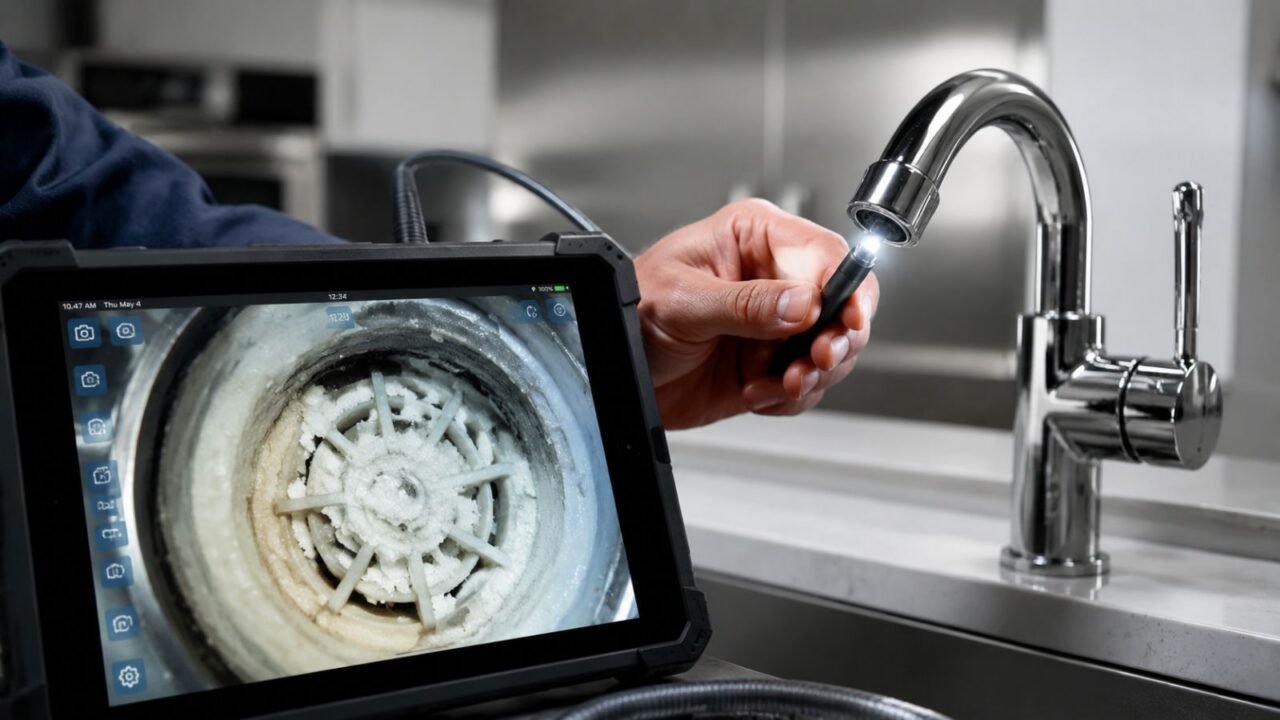
Second, we utilize a high-definition slim borescope to inspect the internal mixing chamber of the aerator. Our “Moment of Clarity” occurs when the borescope screen reveals the multi-stage plastic screens entirely choked by white aragonite crystals, while the outer brass casing remains completely intact. This confirms that a surgical descaling or an aerator-only swap is all that is required to restore full pressure.
We also use thread pitch gauges under the sink. If the scale has crept into the spout’s threads, attempting to force a new aerator in will strip the internal brass, ruining a high-end Moen or Kohler faucet.
Surgical Descaling vs Cheap Aerator Replacement
When dealing with a scaled aerator, there is a right way and a cheap way to address the issue.
- The Cheap Way: Ripping the aerator out with standard pliers. This scratches the spot-resist brushed nickel or chrome finish and strips the delicate threads. Generic shops will often replace the aerator with cheap, un-aerated ABS plastic inserts that degrade and crack under South Texas hard water within months.
- The Five Star Way: We use padded-jaw pliers or custom-fit aerator keys to unscrew the housing cleanly. We then disassemble the multi-stage aerator insert into its individual components. We perform a temperature-controlled vinegar soak (120°F) for 60 minutes to completely break down the aragonite matrix without damaging the plastic.
Furthermore, we always replace degraded inserts with professional-grade POM (polyoxymethylene) aerator cores. Unlike cheap ABS, POM is highly slick, has low water absorption, and resists mineral adhesion, ensuring your faucet runs cleanly even during the humid South Texas spring.
Proactive Methods to Protect Castroville Faucets
You can take simple steps to protect your fixtures from the accelerated scaling caused by Castroville’s climate:
- Wipe the Spout: After washing dishes or hands, use a dry, soft microfiber cloth to wipe the aerator tip dry. Removing the standing water droplets stops the high-humidity carbonation reaction before it can deposit calcite.
- Monthly Vinegar Flush: Spray a mild vinegar solution onto the aerator screen once a month to dissolve microscopic scale before it solidifies into a hard crust.
- Install a Water Softener: The only permanent solution to Medina County’s water chemistry is removing the calcium and magnesium ions at the point of entry. A professionally installed water softener exchanges these minerals for non-scaling sodium ions, ensuring every faucet in your home remains completely free of white crust.
Stop Limescale Damage and Restore Your Faucet Flow
Are you tired of erratic water spray and stubborn white crust destroying your expensive kitchen and bathroom fixtures? At Five Star Plumbing, we provide the master-level diagnostic precision and hard water solutions Castroville homeowners need. Julian Campos and our licensed team specialize in water softener installations and professional faucet descaling. Call Five Star Plumbing at (210) 673-0797 today to schedule your system inspection and protect your home from limescale damage!
Five Star Plumbing
2780 FM 471 N, Castroville, TX 78009
(210) 673-0797)
Your local authority for master-level fixture safety and hard water solutions.
Frequently Asked Questions
Does high humidity really make my faucet scale up faster?
Yes, high relative humidity prevents water droplets on your faucet spout from drying out. This prolonged moisture exposure acts as a catalyst, accelerating the carbonation of dissolved calcium bicarbonate into solid aragonite and calcite scales.
Can hard water scales cause my faucet to leak under the sink?
Yes, when mineral scale severely clogs your aerator, the restricted flow creates high back-pressure inside the spout. This pressure forces water backward past the internal spindle O-rings, allowing water to drip down the faucet body and pool in your cabinet.
Is it safe to clean my high-end matte black faucet with vinegar?
No, direct vinegar soaking can permanently stain or strip delicate finishes like matte black or brushed gold. You must use an aerator key to remove the internal plastic or brass core, soaking only the insert while keeping the outer finish dry.
Will a water softener completely stop aerator scaling?
Yes, water softeners remove calcium and magnesium ions from your water supply through ion exchange. Without these hard minerals present, limescale cannot precipitate on your aerator screens, keeping your fixtures shiny and clear.
